If Freakonomics covered the pitching issue

The provision of pitches by the PR Industry to the receivers of news would appear to suffer from a significant level of inefficiency in the allocation of resources. This is due to PR suppliers charging too high a price for a given level of demand. Over supply to the most in demand journalists leads to frustration for them, and a lack of productivity and efficiency on the part of the PRs, causing reduced profitability.

To improve this situation the industry needs to invest, either internally or via external suppliers, in ways of reducing the price and/or correctly segmenting the news market such that each pitch can achieve the maximum return for the time invested.

The Price of a pitch

Price in this equation is the Price a receiver of PR pitches pays per story they subsequently produce. Before I expand on this a bit of background. Andrew Smith posted last Friday on the topic of pitching and the frustration journalists experience with activities such as phone calls asking “did you receive my email”, the latest being Charles Arthur at the Guardian.

As well as being a chartered accountant I am also an economics graduate (sad I know) so I thought I would try to provide a Freakonomics like perspective on this issue – hence the equation. (By the way if anyone is as sad as me and wants some more detailed graphs etc relating to this analysis then please just let me know :-) )

Getting your story covered is an issue of supply and demand

Supply – the stories pitched by PRs.

Demand – the journalists, bloggers, editors, publishers and broadcasters need for interesting stories for their readers/audience to help fill column inches, web pages, airtime.

The receivers of news choose to write, talk about or publish- the story and therefore it is they who are making the “purchase”.

The Law of Supply and Demand

In a market supply and demand are brought into equilibrium by the price mechanism.

Suppliers want to supply more product as the price rises. Consumers demand more product as the price falls.

At the equilibrium price (PE), the equilibrium quantity (QE) is produced and consumed ensuring an efficient allocation of resources.

The “Price” of a story is a function of the time invested and interest level

From a receiver of news perspective i.e. editor, journalist etc I would suggest that the Price that the receiver of news is prepared to pay to “purchase” a story is the time I have to spend per story that I talk about or publish i.e. the equation at the start:


Investment of time includes the time it takes to review emails I receive, telephone calls made to me – chasing, pitch or otherwise – and meetings, interviews etc.

News market segmentation

The news market though is not a homogenous one. Not all receivers of pitches have the same level of demand.

(It is also worth noting that demand for PR pitches probably shifts on an almost minute by minute basis depending on the availability of other material for articles, blog posts etc but I think I should leave the concept of elasticity of demand and substitutes for another day!)

In demand journalist (Charles Arthur) scenario

The most in demand journalists are highly likely to be generating articles on their own without needing to rely on PR pitches as much for their material. Consequently their demand for pitches is low and consequently the price they are prepared to pay is low – see graph above.

The PR community on the other hand wants the most in demand journalists to talk about their pitches the most and so these journalists probably get sent the most emails, receive the most calls and yet will use the least stories because their demand is low. The effect being that the PR suppliers are expecting this market segment of consumers to consumer a high quantity of product at a high price.

The result – excess supply of pitches in this market segment.

Market implications

In reality there are multiple demand curves as there are many different types of receivers of news.

The best performing suppliers will either be the ones that are able to lower their prices across the board for all receivers and/or ones who segment the market such that they charge the right price and supply the right quantity in each.

For example a publisher of a niche market website publication who has limited in house resources to produce content may see pitches as a good source of material and therefore be prepared to pay a higher price.

Implications for the PR Industry

So how should PRs (and RealWire) seek to improve the situation for Charles and all the other receivers of releases?

Based on my formula above the Price can be reduced by

– Decreasing the investment required of the receiver
– Increasing the proportion of interesting stories they receive

Decrease investment:

To achieve this you need to do things like:

– Make sure they are as relevant as you can make them
– Ensure that the title tells the story effectively, reducing time to establish interest
– That they are in a format that makes receiving easy e.g. no attachments.
– Give them options for how to receive the pitch e.g. RSS

If you have taken the time to do these things well it is more likely that the recipient will invest the time at least reading the subject header of your email. It is then also a question of tracking usage to see if the recipients of your pitches cover any of your stories and trusting that if you have done these things well you don’t need to call everytime.

Effect? Reduced investment on the part of the recipient through reduced emails, less time to establish interest in the story and reduced phone calls.

Increase proportion of interesting stories:

This is clearly a trickier area as a lot is about message, creativity and having compelling stories to tell. I won’t get into what makes for a newsworthy story here as others could cover that far better than I.

However there are other ways of increasing the interest in your story such as using multimedia content – images, audio, video – including links to relevant websites for further information, and including background documents such as technical specifications.

Conclusion

The provision of pitches by the PR Industry to the receivers of news would appear to suffer from a significant level of inefficiency in the allocation of resources. This is due to PR suppliers charging too high a price for a given level of demand. Over supply to the most in demand journalists leads to frustration for them, and a lack of productivity and efficiency on the part of the PRs, causing reduced profitability.

To improve this situation the industry needs to invest, either internally or via external suppliers, in ways of reducing the price and/or correctly segmenting the news market such that each pitch can achieve the maximum return for the time invested.
Monty Python and the 0.5% base rate cut

I replied to a question posted by @wadds this morning about when the base rate economic stimulus would kick in. My answer was that the problem is there is little point in reducing the price of something that you can’t buy.

As I have said before many lenders are not passing on cuts unless they have to contractually and consumers are trapped in current deals because of reducing equity levels. The reality is therefore that for many the base rate reduction doesn’t have much impact.

For businesses it is great as long as they have a fixed margin above base rate. But with most overdraft facilities being on annual terms these margins are likely to be revised upwards offsetting the impact. That is if the facility isn’t pulled completely of course.

Hence the second part of my answer to Wadds. It is like Monty Python’s Cheese Shop sketch. What’s the point of advertising something if you haven’t got the product to sell? Quantitative easing, printing money or any other term you like to use might solve this problem though it could have its own risks. Arguably like waiving chocolate bars in front of someone who is trying to lose weight! Still it would at least mean that the shop would have more products to buy.

IMHO though the real answer lies in creating true wealth not manufactured wealth. To do this requires investment in the one part of the economy that actually creates real jobs – the SME sector. As I have also said in the past the current government has actually taken steps to discourage this not the opposite. Next month Mr Darling should announce radical tax and spending plans to boost the prospects of the engine room of the economy and link this to the government’s apparent Digital agenda. But I won’t hold my breath.

Anyway enough of this lets get to the best part of this post! For anyone who hasn’t seen this sketch before I heartily recommend it and for anyone who has it is always worth another look :-)

Dublin, Guinness and your website analytics

I had a great time last week speaking at the Net Imperative Digital Roadshow in Dublin. Apart from enjoying a great pint of Guinness :-) I found out that Twitter is alive and well in Ireland with over 20 active users in the audience.

As part of my presentation I covered using your website statistics to help you plan and measure the success of your online PR activities. For those of you who aren’t yet active in the online world the following is a (slightly) edited version of an article from my latest Fresh Business Thinking online PR newsletter which covered this topic.

How your website analytics can help your online PR

One of the great things about the Online Media World is that nearly everything you want to monitor or measure is there to be found. In the “real” world it is almost impossible to know what people are saying about you to their friends or colleagues in the pub or round the water cooler. Online there is a vast array of tools which allow you to track what people are saying about you including RSS, social bookmarking and Twitter.

But one of the less obvious PR tools in your armoury is your website statistics package. If you aren’t using a website statistics package yet to track activity on your site then if you only do one thing after reading this article make it signing up for such a service. Google Analytics for example is free, links to their AdWords system and can track multiple websites from one simple to use dashboard.

Why is this relevant to Online PR? Because amongst other things it tells you a number of significant pieces of information about your public relations activity.

1.Referring sites No.1 – You can use your analytics package to tell you if articles that have been written about you in response to, for instance, a news release, subsequently send traffic to your website. Assuming they included a link to your site in the article of course.

2.Referring sites No.2 – What about other news sites that are sending visitors to your website? These sites must be talking about you and by tracking these referrals you can then visit these sites and see what they said and potentially start a dialogue with them if you think you have more information they might find of interest.

3.Referring sites No.3 – Are you getting visits from social bookmarking sites such as Delicious, social networking sites such as Facebook or microblogging sites such as Twitter? If you are then it could be worth your while investing time in finding out what the relevant members of these communities think is interesting enough to spend time sharing, commenting or talking about you.

4.Keywords – The keywords that are driving traffic to your website also gives you an indication of what people find interesting about you. This could be useful when thinking about what stories might be of relevant as part of your online PR activities.

5.Visitor information – Are you getting visits from particular geographic locations? If so are they markets you currently operate in and try and target from a promotional perspective? If not then perhaps it is worth considering engaging these visitors to understand why they find your organisation relevant.

These are just a few examples of how your website statistics can give you an insight into what people find interesting about you and help you to craft a much more effective online PR strategy that is based around starting conversations with people who are relevant to you and about topics they want to talk about.

Profitability of the PRWeek Top150: Scope for improvement?

I thought it was about time I turned my attention back to some good old analysis of numbers. With all the talk about the prospects for 2009 and following on from my analysis of the PRWeek Top 150 I thought I would try and have a look into profitability. But then I thought, why stop there? Why not use my financial skills to come up with some practical suggestions for improving profitability in these challenging times and being an accountant I have even created a spreadsheet so you can test the veracity of my conclusions :-)

As I have already commented, profitability is much harder to get figures on than income. However if one uses income per staff member as a proxy you can start to build a model of the underlying picture.

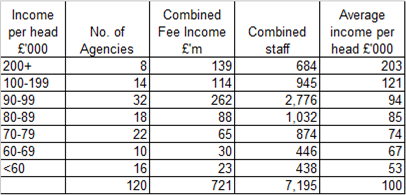
The table below summarises the income per staff member of the 120 agencies within the 2008 Top150 that are based in London or the Home Counties. I have selected these on the basis that they should have relatively comparative cost bases – all things being equal – a simplifying assumption I accept.

PRWeek Top 150 Income Per Head

PRWeek Top 150 Income Per Head

The combined fees of these 120 agencies – £721m – represents 92 percent of the whole of the Top 150.

So what do these figures tell us about profitability? An MD of an agency – name withheld :) – told me recently that £100,000 per staff member was a target figure to achieve circa 20% profitability. It also happens to be the overall average for these 120 agencies – coincidence? Anyway having reviewed the staff costs and margins disclosed in a few of the larger agencies’ accounts I suspect these figures may be a bit on the aggressive side. My guess is nearer 10 – 15 percent at £100,000.

Now obviously different agencies will have different cost structures e.g. premises costs could vary significantly depending on location, but they would suggest a cost base per head of around £80,000-£90,000.

Fight the recession; increase efficiency

From the table we can see that this means that as many as 66 out of 120 agencies might have been struggling to do much more than break even in 2007, the year these figures would have related to (i.e. ones with per head fees of below £90,000). These agencies have a combined income of £206m and employ approx 2,800 people i.e. one in three of the staff in these 120 agencies.

Others have already asked how the recession will affect the PR industry. The above analysis would suggest the first question to ask in return might be how does the industry become more efficient and increase its fee income per head at the same time?

Now I am not naive. I realise that unfortunately these numbers may suggest that there could be some pain on the way, in terms of potential job cuts, for some amongst these firms. However I prefer to drink from a half full glass and see this challenging time as potentially an opportunity for the industry to try and improve this situation in a positive way.

Outsource process work; focus on better audience engagement

I would suggest that there are two areas that could be focused on. Firstly **disclosure here I have a vested interest in this** the industry could benefit from making better use of outsourcing solutions and technology to fulfil more process driven requirements – administration, database building and maintenance, distribution, tracking, reporting, project management/collaboration etc.

This would increase the flexibility of its cost base in these times of uncertain demand and benefit from the potential for these organisations to have better economies of scale and potentially lower overheads and people costs, particularly if they aren’t located in the South East.

The second is to focus on the areas where PR can achieve the most value for the time spent. IMHO (and apologies here to anyone who thinks who is this accountant to tell us PR professionals how good PR works!) I would suggest there is greater value to be secured, for client and agency, by spending more time on:

– identification of the dialogue/s organisations should be having;
– better targeting of the relevant communities they should be conversing with;
– using their creativity to engage with these communities in a more effective and influential way; and
– listening to and learning from these conversations and to the extent that one can, measuring them.

Perhaps this seems like stating the obvious, but I do wonder what proportion of a lot of PRs’ time is actually spent on these activities compared to process tasks as a survey in PRWeek found last year.

A high proportion of this process based work is carried out by more junior staff. A great opportunity exists for instance to employ this capacity in these higher value areas in helping clients engage in the online world, as it is these very staff that are often most comfortable engaging and conversing in online communities.

Greater value; increased profitability  

The effect of these two things would be to increase the potential value per head on the one hand and free up the capacity to do more of this higher value work at the same time. It would also have the added benefit of potentially more motivated staff that are doing more creative work. The top three causes of job dissatisfaction in the Aurum survey being repetition of the same tasks, length of working hours and volume of administration.

My detailed analysis – worked example can be downloaded here, spreadsheet tool here – would suggest that the following could be achieved:

1. More value for the client due to time being spent on added value activities.
2. Improved margins for the agency.
3. Increased motivation and productivity from staff due to reduced hours and more interesting and rewarding work.

What do those who have first hand experience of this think? Am I living on a cloud with the proverbial cuckoo?

Once, twice, three times a presentation

No not a new Lionel Ritchie song, but for anyone who is interested I will speaking at a number of events over the next few weeks.

First up is the Fresh Business Thinking “Hit me – An Introduction to Internet Marketing” on 21st January. Venue for the day is The Royal Statistical Society, London – numbers, right up my street.

Second is the NetImperative Digital Roadshow in Dublin on 28th January. Venue for the day is the Guinness Storehouse – even more up my street! :-)

Finally I will be speaking as part of the Media Trust’s PR Strategy and Planning training day on 3rd February. Location to be confirmed but will have to be pretty good to top the Dublin one :-)

If anyone is interested in attending either contact the organisation concerned or let me know.