Background
RealWire has been offering the Social Media News Release (SMNR) option to our clients for nearly two years now. In that time we have hosted and distributed over 200 SMNRs on behalf of a varied group of organisations including:
3i, Adobe, British Army, Cisco, Comic Relief, Cross Country Trains, Diageo, Durex, First Direct, Ford, HSBC, ITV, Macmillan Cancer Support, Nescafe, NSPCC, Peugeot, Sage, Skoda, Sony Ericsson, Symantec, Talk Talk, Toshiba, Twestival, Vauxhall and Volkswagen. Some are in a narrative style, some follow the original deconstructed format.
Our video about the SMNR (from our webitpr days) has had over 12,000 views and we are currently ranked top of google.co.uk for a search for “social media news release”. Even ahead of Mr Social Media Release himself, Todd Defren. (Of course we don’t manage to repeat the trick on Google.com, but the video doesn’t do badly  )
)
So it is on this basis we feel fairly well qualified to provide some analysis on whether Social Media News Releases actually achieve better results than “traditional” press releases.
Analysis
We analysed 997 releases distributed by RealWire during the period December 2008 to May 2009 for which coverage tracking statistics had been gathered by our Proveit release evaluation service.
Of these 71 releases were Social Media News Releases.
The results are summarised below:
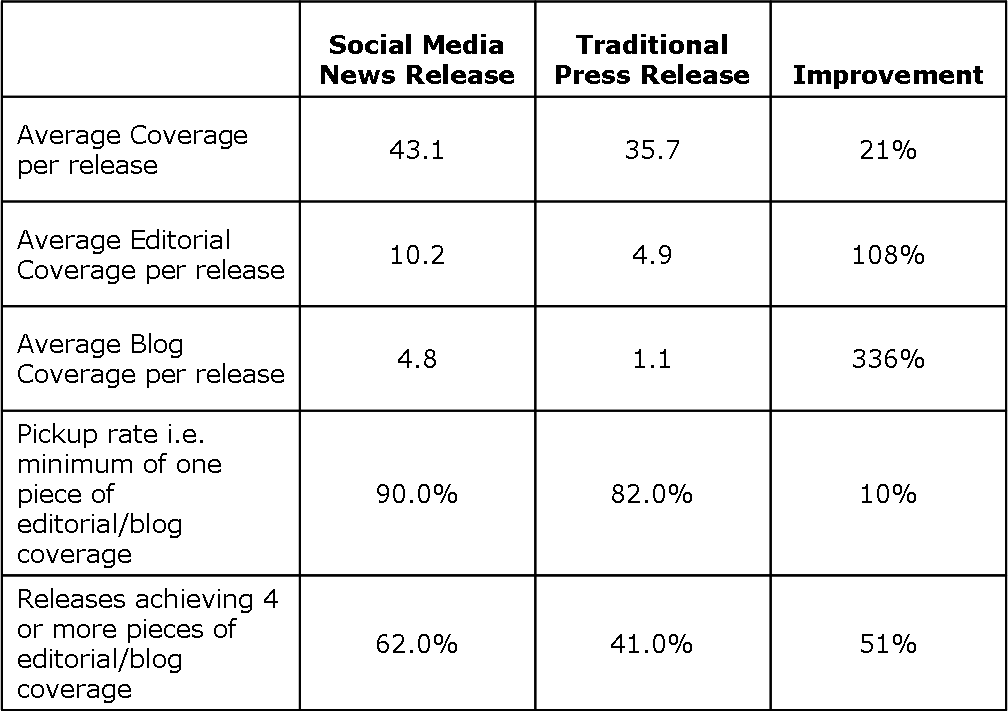
Total coverage includes coverage that is the republishing of the release in its entirety either by selective or non selective publishers.
It is worth noting that all of these results for both SMNRs and traditional releases compare favourably with analysis of competing distribution services suggesting that the combination of our clients, their releases and RealWire’s approach performs strongly for all types of release.
However the results above suggest that Social Media News Releases perform substantially better than traditional releases when it comes to generating editorial and blog coverage with, on average, all of the additional coverage being of this type.
So a big tick in the box for SMNRs then? All we have to do is produce all releases in this format and we will all achieve two or three times as much coverage?
Well not so fast. A simple regression analysis on the data suggests that a release just being an SMNR, as opposed to a traditional release, in itself only explains a small proportion of the variation in the performance of individual releases.
So the majority of the variation would seem to be due to other factors. There are any number of factors that could explain some degree of variation – the hook of the title, timing, number of interested parties etc. Significantly more detailed work would be needed to prove the impact of each.
But I would suggest that the most likely reason for the improvement in performance of SMNRs is that the additional investment needed to produce a SMNR means that clients are more likely to use them for the most interesting stories. It is this investment in quality that then pays dividends with the features of the SMNR allowing the user to enhance that storytelling and so produce the improved results.
Implications
Less stories. More creatively told. To the right people.
The first point may seem like a strange thing for a press release distribution company to say – “less stories”, doesn’t that mean less business? As I said earlier, the results of our own distribution actually indicate that releases we distribute for our clients are already of a relatively higher quality and/or are directed to more relevant people and hence our pickup stats compare very favourably to competing services.
However the analysis implies that the discipline of investing more in the telling of a story through a Social Media Release seems to lead senders to focus on the stories that generate the most interest editorially and from bloggers. Surely that is a good thing for all parties?
When 54% of press releases from the big wires apparently never get written about, wouldn’t focussing more on the half that are of interest be a better use of the PR industry’s resources?
 I am taking part in ByteNight 2009 on 2nd October. Byte Night is an annual event where hundreds of people from the IT and business community agree to sleep rough for one night to raise money for Action for Children who help the UK’s most vulnerable children.