Posts Tagged ‘measurement’

Social Media News Releases achieve three times the pickup

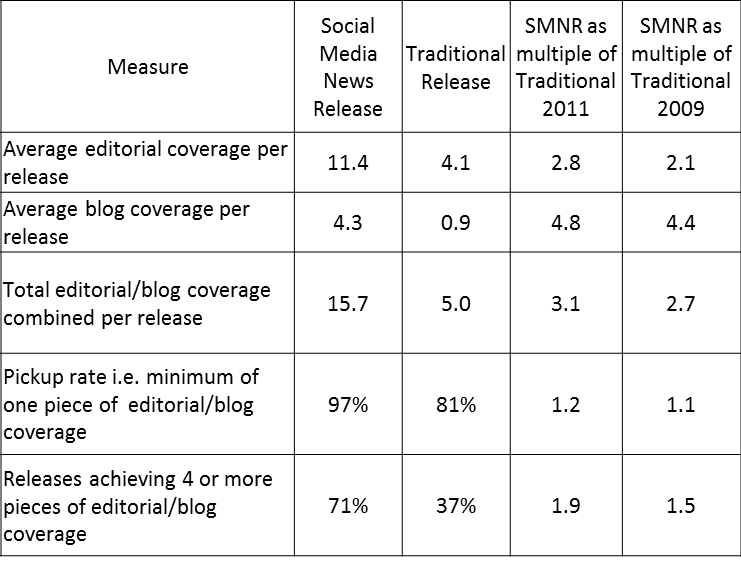
In the summer of 2009 we did some analysis looking at whether Social Media News Releases (SMNR) achieved more coverage than “traditional” press releases. The analysis of almost one thousand releases showed that SMNRs distributed by RealWire generated twice the editorial coverage and almost four times the blog coverage.

A few weeks ago whilst discussing the timing of a FIR interview with me on the value of press releases (which is now published here by the way) Shel Holtz asked me if I had any plans to update the research. As it had been over 18 months this seemed a good idea so I booted up Excel and here are the results

Social-Media-News-Release-Coverage-Analysis-Results-2011

1,044 releases were analysed from those distributed in the 6 months from September 2010 to March 2011
Coverage is data is based on RealWire’s Proveit coverage tracking and evaluation service
79 were Social Media News Releases (releases related to 62 different companies, across 21 different industry sectors)
965 were “Traditional” Releases  (releases related to 339 different companies, across 28 different industry sectors)

So overall the sample of SMNRs achieved over three times as much editorial/blog coverage on average (15.7 pieces v 5.0 pieces) as the “traditional” releases.

Some examples from different sectors of high performing SMNRs include releases by Panasonic, Alterian, 3M, Warner Bros, Rolls Royce and Aviva.

As with the previous analysis I think one of the primary reasons for the difference in performance is that the additional investment that can often be required to produce an SMNR – multimedia assets, links to background research etc – means that they are used for stories that the sender perceives are potentially high impact and therefore likely to be of interest to a wide audience.

Another reason could be the lower proportion of B2B releases in the SMNR sample. However I am not necessarily convinced this is the case as there are plenty of examples of B2B releases in the traditional sample that performed to a similar level as the best performing B2C SMNRs.

As I indicated in my interview with Shel I think it is more likely that a higher proportion of traditional releases are more informative in nature e.g. new appointment, new customer, financial results, tradeshow attendance etc. These stories are of potential value to relevant publications, but it is likely that the number of such publications will be lower than where the release is around a broader topic of conversation e.g. research, market changes, new products etc. If people would find this of interest then let me know in the comments as further study of the nature of the releases themselves might shed some more light.

In the meantime on a short promotional note it is good to see that our overall pickup stat of 80%+ of releases gaining editorial/blog coverage still compares very favourably with our competition :-)

Tuesday, March 22nd, 2011

PRFilter Technology PR Rankings launched

The PRFilter platform has been publicly live for a month now and in that time there have been thousands of searches performed. But as well as finding relevant press releases PRFilter now has a wealth of data on press release content.

Independently Adam Sherk last month used PRFilter to look at how often buzzwords are used in releases – read more about it here. We  in turn thought it would be interesting to look at which technology brands, topics and products have been talked about most in press releases over the last couple of months. As an industry there is a lot of time and money spent analysing what the media writes/talks about, but what are PRs trying to talk about and do the two things fit?

Thats why we have produced our first PRFilter Technology PR Rankings. These rankings analyse the tens of thousands of releases indexed by PRFilter each month and look for the most talked about technology brands, topics and products within them.

Highlights from this first month (February 2011) include:

  • MicrosoftFacebook and Verizon were the top three most referenced technology brands.
  • Cloud related technologies, websites and wireless were the top three most referenced technology topics with iPhone and iPad the top ranking products.
  • Mentions of Microsoft and Facebook were around twice the number of Apple (ranked 5th).
  • Releases mentioning “cloud” technologies were more than twice as frequent as those referencing “social media”, however this was down from three times as frequent in January.
  • iPad related releases were down 37% perhaps reflecting a calm before March’s iPad2 storm.
  • Significant increases in mentions of telecoms brands e.g. EricssonNokia and ZTE and technologies e.g. LTE and NFC, reflecting the hosting of Mobile World Congress during the month.
  • A presentation of the full details of the Top 25 technology brands and the Top 50 technology topics/products can be found here or view below.

    This first month’s rankings demonstrate that a large number of stories are being created around certain brands and topics and not all of these are necessarily in areas that are likely to provoke great interest from the media.

    We hope that producing these monthly rankings will assist public relations practitioners in developing a higher proportion of stories that journalists and bloggers find of interest and lead to improved coverage for the companies concerned.

    As this is the first month there are bound to be things we could do better or information people would like to see next time so please let us know in the comments.

    We have also started with Technology because that was the sector PRFilter was initially focussed on when it was first launched. However if there is demand we will look to expand the rankings to cover other sectors. Again feel free to let us know.

    Wednesday, March 16th, 2011

    Online readership analysis – is bigger better?

    Following my post the other week regarding online readership, sparked by some aggressive sales tactics by one of our competitors, I got talking to Andrew Smith of Escherman and we agreed to jointly carry out a more extensive piece of analysis looking at 50 different online news sites.

    We selected ten sites each from the following areas – UK Nationals, Business, Marketing, Technology and Consumer. There was no particular selection process, just an attempt to have a reasonably representative sample and we both hasten to state that this is a relatively limited exercise which should therefore be taken with at least a pinch of salt. Particularly since indexed urls have been used as a proxy for content as this can be impacted significantly by site structure (as stated in slide 21), with some sites having sub domains and/or a more complex content directory structure.

    However at the same time with the data that is readily available we think it provides some (arguably) valuable food for thought. So after several hours of research, number crunching and graph generation here are the results (I suggest you view in full screen mode unless you have excellent eyesight):

    Site data is sourced from Google for the number of indexed urls via the “site:domain” command and from AdPlanner for the traffic data.

    Online news titles readership and engagement analysis 280710

    View more presentations from RealWire.
    We are effectively looking at three areas:
    Readership per article – average numbers of UK page views per Google indexed url per month. Where indexed url is a proxy for the number of likely visited pieces of content.
    Engagement – time spent per page to indicate how long a reader is likely to be spending reading that content when they get there.
    UK Relevance – what proportion of the sites readers as a whole come from the UK and would therefore be likely to be relevant if you were trying to reach a UK audience.
    Andrew has provided his take on the results from a PR perspective here. For my part the highlights are:
    Readership
    Unsurprisingly readership per article is much higher for UK Nationals and Consumer than the sector specific publications. However within the performance of UK Nationals and Consumer a handful of sites stood out for having particularly high UK traffic per article being, in order, News of the World, Heat, The Sun, The Mail, Closer Online and Marie Claire.
    Interestingly though if you remove these six high scoring sites from the samples then the sector specific sites still achieve, on average, between 30-60% of the readership per article of the remaining UK Nationals or Consumer titles.
    Within the sector specific titles there were equally some significant differences in results with Techcrunch Europe, The Register and T3 being at the top end in views per url in Technology; Marketing Week and NMA in Marketing; and is4profit, Startups, Businesszone and Real Business above the average in the Business group.
    Engagement
    The top six engagement scores were achieved, in order, by Reuters UK, Information Age, Financial Times, Business Zone, The Independent and The Register. A very different result to the readership per url figures.
    This difference was further underlined with the Business and Technology sites achieving on average approximately twice the time spent as Consumer sites. Evidence for both more in depth content and greater engagement, which doesn’t seem surprising.
    Relevance
    There are significant differences within each group with regards to proportion of UK traffic. Within UK Nationals the tabloids are generally between 60-75% UK based with the qualities between 30-55%; the FT having the lowest UK traffic proportion with 31%.
    Within Business titles the vast majority of sites are UK focussed and because of this their audiences are predominantly UK based also. The exception being The Economist with only 7% of its audience being from the UK according to AdPlanner. Interestingly this seems to reflect the broad geographical interest of its content with even the US only accounting for just over a third of its traffic.
    Its a similar picture within the Marketing titles with the vast majority of traffic to the sites selected being  UK based. The marketing publication with the lowest UK proportion is Econsultancy with 57% from the UK. This in in part due to around 20% being from the US which seems consistent with their having a US presence.
    Finally Technology and Consumer titles have quite varied levels of UK traffic with sites such as Techcrunch Europe and Vogue.co.uk (clearly having the potential for interest from outside the UK) having lower proportions of UK traffic at around 20-40% compared to sites such as T3 and Heat which are between 75-100%.
    Conclusions
    Though limited the analysis provides evidence for savvy PR people who already know that it is important to ensure that you understand the publications they engage with and their potential to actually reach the readers and communities most relevant to them and their clients and not be blinded by big traffic numbers.
    There are many other points that could be drawn out of the results and we would love to get feedback from people on anything they observe or suggestions as to how to refine the analysis and improve the validity of the results.
    Notes
    The other publications analysed not mentioned above were:
    UK Nationals
    Express, Mirror, Daily Star, Telegraph, Guardian
    Business
    Management Today, Business Wings, Growth Business, Fresh Business Thinking
    Marketing
    PRWeek, Brand Republic, Mad, Marketing Magazine, The Drum, Journalism.co.uk, UTalkMarketing
    Technology
    Computer Weekly, Computing, EWeekEurope, ComputerWorld.com, ZDNet.co.uk, Silicon.com
    Consumer
    Cosmopolitan, Grazia, All About You, GQ Magazine UK, Maxim UK, Handbag

    Friday, July 30th, 2010

    Online Visibility-its not the size of your traffic that counts

    At RealWire we have recently become aware that a major wire service is making a big deal out of their website’s high traffic numbers. In fact they have been specifically targeting the market trying to argue that their service is hugely better where visibility is concerned.

    However they don’t mention the following three crucial issues about the traffic to their site.

    1. That volume of traffic is clearly going to be affected by quantity of content.

    2. The time visitors actually spend reading their content.

    3. The relevance of those visitors to the content.

    At RealWire we are always keen to make sure that discussions are based around the facts so let’s look at each of these in turn to see how our readership, engagement and relevance are all in fact apparently superior to Big Wire Corp’s.

    Quantity of content

    Q: Which is the more “popular” of the following two sites?

    Site A – 1 piece of content and 1,000 page views in a month
    Site B – 1 million pieces of content and 1 million page views in a month

    Well according to their literature Big Wire Corp would apparently see Site B as a more popular destination because it has 1,000 times more page views. Makes sense, bigger is better right? Wrong.

    Site A’s one piece of content has been viewed 1,000 times, whereas each of Site B’s stories has only be viewed once on average. Now which site is more popular? Site A of course.

    Now let’s apply this concept to Big Wire Corp’s website.

    First of all let’s get an idea of volume of content. The Google “Site:[url]” command gives you the number of unique pages indexed by Google on a particular site – a good proxy for the amount of content.

    In this case the answer is 406,000.

    Next we need an idea of traffic to the site. Google AdPlanner provides estimates of monthly page views.

    In this case the answer is 7.5 million

    If we then divide page views by content, we get an estimate of the number of views per article per month. Answer 18.5.

    RealWire’s equivalent data from the same sources is
    Content – 5,500
    Page views – 200,000* (less than 3% of Big Wire Corp’s figure)

    This gives 36.4 page views per article per month.

    Twice the Big Wire Corp figure suggesting RealWire has higher readership for each article.

    *I happen to know that the page view figure is too high in RealWire’s case (we do have analytics of course) but it could equally also be so for Big Wire Corp and so until I can get a hold of actual numbers for them I am being consistent.

    Engagement

    Q: Which of these two sites is engaging its readership the most?

    Site A – average time spent on each page 2 minutes

    Site B – average time spent on each page 5 seconds

    Site A obviously. Each of the readers are spending 24 times longer reading an article on average than on Site B.

    So let’s apply this to Big Wire Corp again.

    Again Google AdPlanner can help. It tells us how many visits the site receives and how long each one lasts. From this we can get Time spent per Page as follows:

    Time spent on page calculation

    Big Wire Corp numbers

    Time spent per visit = 3 minutes 50 seconds (230 seconds)
    Total page views = 7.5 million
    Total visits = 3.5 million

    Time spent per page = 107.5 seconds or 1 minute 47.5 seconds

    RealWire numbers

    Time spent per visit = 8 minutes (480 seconds)
    Total page views = 200,000
    Total visits = 64,000

    Time spent per page = 153.6 seconds or 2 minutes 33.6 seconds

    43% more than Big Wire Corp suggesting readers of RealWire content are more engaged.

    Relevance

    Q: Which of these two sites is most likely to have the most relevant readership to a UK relevant story?

    Site A – 100% of visits from the UK

    Site B - 1% of visits from the UK

    A: Site A – Yes I know these are getting ridiculously easy now! :-)

    Big Wire Corp’s market report focusses on US usage of their site when comparing themselves to others such as RealWire. However given that the vast majority of their content is from US companies it will come as no surprise that the vast majority of their traffic does as well. Google Ad Planner again helps us out.

    US traffic – 76% of total

    But the majority of RealWire’s clients and therefore content are from the UK. So what’s Big Wire Corp’s UK traffic like?

    UK traffic – 3% of total.

    And RealWire’s UK traffic? Well AdPlanner estimates around 75% but the real figure is nearer 45% or 15 times the Big Wire Corp figure.

    Suggesting that RealWire’s traffic is around 15 times more likely to be relevant.

    Conclusion

    When evaluating traffic between sites it is imperative that you don’t get drawn in by the size of headline traffic numbers and that you consider:

    a) normalising traffic for levels of content

    b) how engaged the readers are

    c) how relevant the readers are

    Or you could find yourself reaching some very misleading conclusions. Just ask Big Wire Corp :-)

    * Hattip to Andrew B Smith for highlighting the value of Google Adplanner for such analysis

    Thursday, July 15th, 2010

    Fear or Value – which one is “selling” social media?

    Salems Lot When considering making a purchase as a business there are arguably three forms of justification – need, fear or value. By need I mean an absolute requirement for something i.e. you cannot operate without it. By nature these aren’t the decisions that you spend very long thinking about. The other two are where the majority of consideration comes in.

    Fear – To a certain extent this is the more irrational of the two. What if I don’t do this? What won’t I know? What will people think? What if my competitors do or perhaps they already are?

    Value – This is the more rational. If I do this I will derive this much benefit.

    In the recent Econsultancy Social Media and Online PR Report (well worth reading) amongst many interesting statistics a few that jumped out at me were in connection with organisations’ (Figure 17) and Agencies’ (Figure 19) views of the potential value of social media.

    Open minded but not convinced of its value

    Presents major challenges and risks for their business

    Agency view of Clients

    64%

    15%

    Organisations themselves

    44%

    19%

    Two points jump out at me from these stats. Firstly that Agencies think organisations are more sceptical about value than Organisations apparently do themselves. Perhaps this is due to lack of follow through on spending decisions?

    Secondly that in both cases these figures imply that value is seen as a much bigger challenge to the argument for engaging in social media activities than the challenges and risks.

    This is borne about by the findings of Figures 48 and 50 where from both Agency and Organisation perspectives 60% of respondents considered they had achieved some benefit from their social media activities but nothing concrete.

    So with the vast majority of respondents seeing no concrete value in what they are doing does this suggest that fear – fear of what is being said about you, fear of missing an opportunity – is playing more of a role in justifying investment in social media than value?

    Oh and the picture is from the 1970s TV version of Salems Lot and this scene was quite simply the most scary experience of my life at the time and I have never forgotten it!

    Tuesday, December 8th, 2009

    Adam Parker

    About...

    This is the Blog of Adam Parker, Chief Executive of RealWire